


Paper carving is one of our traditional crafts. However, works carved with paper as materials are easily damaged and difficult to keep. In order to better restrain this shortcoming, Quanzhou arts and crafts master Lu Lighting boldly innovated and used special materials to create more agile, smooth and exquisite description works.
What is a film?

Quanzhou arts and crafts master and Chinese literati description artist Lu Guangming is a folk artist. He has worked as a printer, part-time painter, graphic designer, etc., and has experienced "real life" in the art world of description.
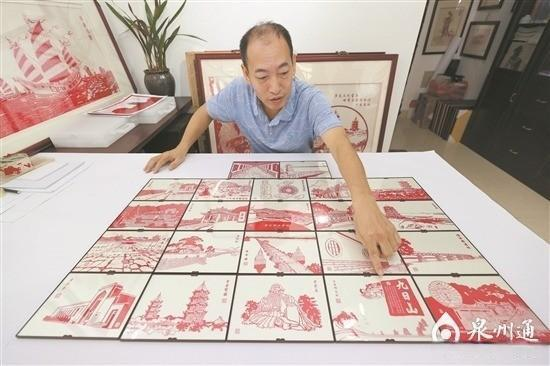
Free Guanyin, Duhai Bodhidharma, Jiuri Mountain, East-West Pagoda, Laojun Rock, Ancient Dacuo... a statue of Buddha, one by one, the marks of southern Fujian are portrayed in one stroke of his stroke, which is amazing and amazing.
Lu Lighting learned printing skills in a printing factory. Later, he separated from the printing factory and started his own business, undertaking work related to industrial design including packaging design and LOGO design. In his spare time, he still insisted on drawing and bought a set of carved paper from "The Story of the West Chamber" and copied it for comparison. Later, he played with paper cutting. At that time, digital cameras had become popular, and film paper was abandoned. Lu he suddenly thought: "Since you want to throw away the film paper, it is better to try to outline the "Three Sheep Kaitai" on the film paper." After some attempts, unexpectedly, the lines of the work carved out of the film are clever, Fluency and precision are quite surprising.
This new discovery made Lu Guangming impulsive. Since then, he has started more and more experiments, experimenting with film paper to carve various types of patterns, gradually understanding the traditional paper cutting in an all-round way, and trying different paper cutting techniques to adapt to the new Data attributes...
He named this new type of artistic method "Description", to express his inner aftertaste of paper-cutting and his love for painting. As a result, the artistic life that was once embellished has renewed its vitality in Lu Guangming's body.
According to Lu Guangming, the expression of description is similar to that of traditional paper-cutting, and the technique of using a knife is slightly different. The traditional cutting paper is to use a vertical front-to-back angle jigsaw-style knife to tie up the entire stack of paper. The stroke described is to pull quietly at an angle of about 45 degrees on the data. It is necessary to control the force and skill in the stroke. The material used is not paper, but a special material called film (similar to the film negatives used in previous photography). This material is a kind of red transparent plastic hard film, which is sprayed with a very thin mist of powder, also called medicated surface, and under the medicated surface is a relatively thick transparent hard film. Paste the drawn manuscript under the data before engraving, and you will be able to see the manuscript pattern underneath. When engraving, the knife must be slanted, pulled quietly, and not too hard, otherwise the knife will damage the transparent hard film under the surface of the medicine; nor can you rub or touch the surface of the data with your hands, otherwise it will leave fingerprints and cannot be wiped. Falling; not to have creases, otherwise it will affect the effect.
There is an obvious advantage of using film as materials, that is, the lines do not need to be connected and will not fall off. However, the strength of the cutting time and division knife should be accurately controlled to only cut through the outer layer of medicine, not the underlying film base. Leave the necessary parts in place, and pick out the unnecessary ones quietly with the tip of a knife. The speed should be fast, and no knife marks should be left. Every time you make a knife, you must be very careful, precise, and in place. Once it shows up, it can't be repaired, and you're done. Therefore, you must have enough patience and concentration at the moment, and don't have evil thoughts. This is actually an artistic method and traditional technique that cultivates attention and patience.
Breaking the Tradition and Describing Quanzhou's Various Forms
Studying painting since childhood has made Lu Yingming's artistic skills deep, but when it comes to description, he needs to accumulate across the board and practice hard for many years. These can be seen from the detailed textures of the portraits under his sword, which are vivid in appearance, natural posture, fluent in clothes, and beautiful in costumes.
For example, in the work "Viewing Freedom Bodhisattva" under Lu Yingming's carving knife, the Bodhisattva sits in a chic and casual posture, with his left foot on the lotus, his right foot on the stone bench, his right arm naturally stretched against the knee, and his left hand supporting the stone surface, Tao Ran contented. The most wonderful part of this work is the charm, a charm that seems to penetrate the world's "five aggregates are all empty", and what supports this charm is his swaying but refined and rigorous "knife technique", the bodhisattva's body The cloak is fluent and fluent, it seems that the place where the Freedom Bodhisattva walks and sits is naturally immortal.
For another example, in the work "National Hero-Zheng Shengli", Lu Guangming uses point, line, and surface organic and reasonable description techniques to reproduce the scene of Zheng Shengli's recovery of Taiwan. The horse is strong and mighty and lifelike, and Zheng Shengli on the horse wears armor and holds a single-tube telescope in a relaxed manner. It was amazing to see the horsehair, beard and dragon scales. Extensive carving techniques and common selection of materials make this work look more flat and vivid.
Zeng Yongqing, a brick carving artist in Quanzhou and the president of Wanyin Society, said that Lu Guangming described the courage to break traditional methods and bring a new artistic style to Quanzhou. Growing up in Quanzhou, Lu Lighting is willing to showcase the scenery of his hometown, such as the "Quanzhou Folk House Ancient House" which won the silver award in the 9th National Strait Craft Fair. Ground carving integrates various techniques such as the five-frame structure, wood carving and stone carving of ancient buildings in southern Fujian. The several works of the "Quanzhou Religious Series" present the multicultural landscape of Quanzhou that accommodates all phenomena to the world. The integration of Buddhism, Manichaeism, Islam, Christianity and other religious cultures in Quanzhou shows the profound charm of the ancient city’s history.
Lu Guangming even expressed Quanzhou in a super-realistic way based on the original. The description and display of the original scene, coupled with artistic creation, make "Quanzhou on Paper" vivid. The ancient houses of Quanzhou, the swallowtail ridges of traditional houses, the brick-carved stone lions, the Tianhou Palace, the Kaiyuan Temple...Under the carving knife of Lu Guangming, these southern Fujian scenery is immeasurable: the fluent red and white lines, the delicate bricks and tiles of the southern Fujian architecture To show it.
"Quanzhou has a deep history, and I will further study these themes in the future." Lu Guangming, who was born and raised in Quanzhou, has a special liking for hometown themes, and has innovative expressions in the way of description, cleverly separated from history, and spread the charm of the ancient city.
Descriptive art
Inherit the Minnan culture
Wan Dongqing, president of the Quanzhou Branch of the Fujian Provincial Collectors Association, believes that Lu Yingming’s depictions are mainly based on southern Fujian culture, religious culture, and my country’s traditional and ominous culture, with a distinctive style.
“Learning from tradition, separating modern art from time to time, using traditional paper-cutting as the core, modern art as the spirit, and personal emotional thought as the driving force for creation. This is the direction for future efforts to describe art.” In the description works created by Lu Lighting , Absorbing the attention of more and more contemporary people with multiple perspectives and aesthetics.
Lu Guangming often encounters many difficulties in his creation. For example, when using a knife with a special material, it requires high stability when using a knife. It cannot be too light or heavy; for example, the longest arc of "Yang Zhi Guan Yin" must be carved in one stroke. For example, in a 1 cm space on the forehead of Guanyin, a small Guanyin with eyebrows and eyes should be carved out.
The color of the film paper is pure red. As the eyes face red for a long time, Lu Lighting's eyesight will inevitably be affected. Originally, only one table lamp was needed in the creation, but usually had to be increased to two. Lu Guangming said that maybe in three to five years, when my eyes are getting worse, I can no longer engrave too detailed pictures.
Because of this, he strives to persist in creating, so that more people can see the best description works. He knows that if he can't continue to create, this art form will disappear. Therefore, he wants to find a few people who are in harmony and have a talent for description to pass on this art of description.
Lu Yingming’s father is Quanzhou marionette veteran artist Lu Yixing. Lu Guangming said that he has inherited his father’s family tradition of "teaching the talents" and has continuously assumed the responsibility of passing on Quanzhou culture. The common charm is undoubtedly a fluke." Lu Guangming said that it is the fusion of Quanzhou's diverse cultures that provides a source of material for his creation from time to time, and the common charm of paper-cutting techniques makes these common Quanzhou symbols shine with infinite brilliance. .
Zeng Yongqing said that the folk craftsmen in Quanzhou uphold the confidence to record and inherit the traditional culture of southern Fujian with their skills. The craftsmen of southern Fujian are cherishing their love for the culture of the birthplace, and devote their efforts to the continuation and innovation of the splendid and splendid culture of southern Fujian.
Source: Quanzhou Evening News
